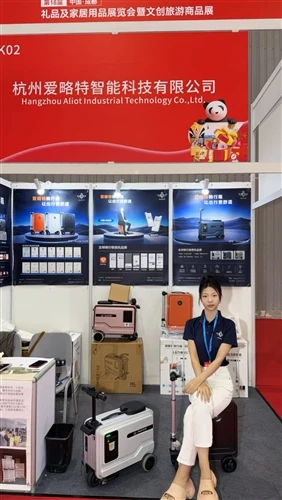
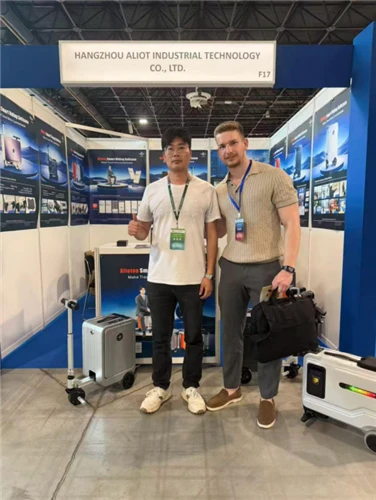
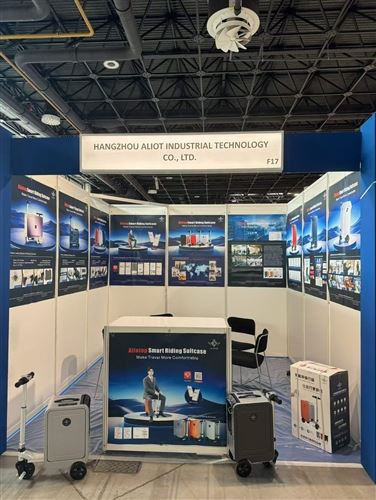
With the popularization of the smart travel concept and the advancement of consumption upgrading, smart rideable luggage that integrates storage and mobility has quietly gained traction, emerging as a new choice for young people and business travelers. This innovative product, which breaks the single-function limitation of traditional luggage, relies on high-quality, durable materials and time-saving, labor-efficient design. It not only solves the travel hassles of long-distance trips but also drives the transformation of travel gear toward intelligence and multi-functionality, with the relevant market scale sustaining rapid growth.

Compared with traditional luggage, the core advantage of smart rideable luggage lies in its integrated "riding + storage" design, which completely changes the traditional "pull and hurry" travel mode. Reporters' market research shows that mainstream rideable luggage is all equipped with a powerful brushless motor, and the front wheels adopt a retractable structure. When extended, the wheelbase widens, making it adaptable to various scenarios such as airports, high-speed rail stations and scenic spots, and ensuring a smooth ride even over speed bumps. Its riding speed can reach 10 km/h, far exceeding walking speed, which greatly saves time for rushed travelers-an ideal choice especially for travel scenarios with heavy luggage and tight schedules.
Operational convenience is an added bonus for rideable luggage. Most products feature a minimalist control design: the right handle accelerates and the left one brakes, allowing beginners to master the operation quickly. Some high-end models are paired with a smart app, which enables real-time checks of riding speed, battery level and mileage. It also supports remote control of front wheel retraction and speed limit setting, realizing seamless switching between riding and pulling modes without the need to bend over. Meanwhile, rideable luggage retains the pulling function of traditional luggage, with a 360° universal wheel design for flexible steering. When not in riding mode, it functions just like ordinary luggage, meeting diverse usage needs.
In terms of material selection, rideable luggage balances sturdiness and lightweight design to withstand bumps and knocks during travel. At present, the shells of mainstream products on the market are all made of ABS+PC composite material, which combines high strength and toughness, offering scratch resistance, wear resistance and impact resistance to effectively protect the safety of luggage inside. The frames are mostly made of aviation-grade aluminum-magnesium alloy, which undergoes special reinforcement treatment-they will not deform even with long hours of riding and can bear a load of more than 110 kilograms, meeting the riding needs of adults.
Tailored to travel scenarios, rideable luggage features more thoughtful design and material choices in details. It adopts a modular lithium battery design with a capacity of about 92.5WH. The battery has passed the 3C certification and complies with the transportation specifications of civil aviation and high-speed rail. It can be quickly disassembled without any tools, ensuring a smooth security check. The luggage cover is mostly designed with a side-opening structure and equipped with adjustable buckles, which can be opened at 45° and 90°, facilitating the temporary access to items in narrow spaces. A USB charging port is commonly installed on the outside of the case, enabling on-the-go charging of mobile phones, tablets and other electronic devices and solving the battery anxiety during travel.
According to industry reports, the market size of China's rideable electric luggage reached 4.68 billion yuan in 2025 and is expected to rise to 5.73 billion yuan in 2026, a year-on-year increase of 22.4%. The core consumer groups are urban white-collar workers and college students aged 25 to 35.
Insiders in the industry stated that the popularity of rideable luggage is the result of the in-depth integration of technology and travel demands. Its material upgrades and optimized convenient functions have accurately addressed the pain points of modern people's travel. However, the industry still faces challenges such as unclear safety supervision and homogeneous competition. In the future, with technological iteration and improved standards, rideable luggage is expected to achieve further breakthroughs in material lightweighting and functional intelligence, bringing a better travel experience to consumers and promoting the continuous improvement of the smart travel ecosystem.