


How much does the Ride On Travel Suitcase cost?
Nov 12, 2026
Leave a message
If you’ve ever stood in an airport with a giant suitcase you’re struggling to lift, or spent extra on a flight because your bag was a few pounds over, you know the pain point I’m talking about. As a supplier of Ride On Travel Suitcases, I get asked this question all the time: “How much does one actually cost?” It’s not a straight-up number, I’ll admit—there are a bunch of factors that play into the price, and I want to break them down honestly, no sales fluff.
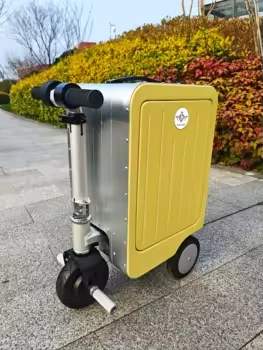
First, let’s clarify what a Ride On Travel Suitcase even is, because not all of these are created equal. A lot of people mix them up with regular rolling luggage, but our line is the kind you can actually ride on—think of it as a mix between a smart suitcase and a short-distance electric scooter, perfect for airports, convention centers, or even a quick zip around campus. That’s why you’ll see products like the Short-Distance Commuting Electric Scooter Smart Ride-On Suitcase as a core part of our lineup; it’s designed to solve that “I have too much stuff and too far to carry it” problem.
Now, let’s get to the cost. The biggest variable here is the features and build quality, because a $100 “ride-on suitcase” from a random brand is way different from what we offer. For starters, our entry-level model, the Electric Mini Portable Aluminum Smart Suitcase, is priced at a point that makes sense for people who want the basic perk of riding instead of pulling. We used lightweight aluminum for the frame here, which keeps it under the airline’s carry-on weight limit most of the time, and it has a 250W motor that’s enough for flat or slightly sloped surfaces. The price on this one lands around $350, but it’s worth noting that this is for the model with no frills—no built-in charger, no tracking, just the basics to get you riding.
If you want more, the mid-tier option is the Portable All-in-One Smart Riding Luggage. This one adds a few game-changing features: a built-in USB port to charge your phone on the go, GPS tracking so you never lose sight of your bag, and a slightly bigger motor for hilly areas. The aluminum frame is still there, but we upgraded the battery to a 10,000mAh unit that can power both the scooter function and your devices. That extra tech pushes the price up to around $550, and honestly, for frequent travelers or people who hate digging for their chargers at the airport, that’s a steal.
The top-of-the-line model is the All-in-One Smart Riding Luggage (yes, it sounds similar to the mid-tier, but it’s way more advanced). This one is made with a magnesium alloy frame, which is stronger than aluminum but still lightweight, and has a 500W motor that can go up to 10 mph—fast enough to cut your airport travel time in half. It also has a digital display on the handle that shows your speed, remaining battery, and even the weight of your bag, which ties into why we carry the Electronic Digital Portable Luggage Weighing Scale as a complementary product. If you’re someone who gets hit with overweight bag fees all the time, that built-in weight feature alone is worth the extra cost, and the top model runs about $850.
Wait, but I know what some of you are thinking: “Why is this so much more than a regular suitcase?” Let’s do a quick cost breakdown to make it make sense. A regular hard-shell carry-on is around $100, but it only rolls—you still have to carry it when it’s too heavy, or push it through crowds. A standard electric scooter is at least $200, but it doesn’t hold your clothes or laptop. Our Ride On suitcases combine both, so you’re not paying for two separate products, you’re paying for a single, multi-use item. Plus, we use better materials than most budget brands—we test every single model to make sure it can hold up to being checked, dropped, and ridden for miles, which cuts down on replacement costs long-term.
Another thing that affects price is where you’re buying it. If you pick up a Ride On suitcase from a big-box store, you might pay a little more because they mark up to cover shelf space, but if you go through a supplier directly—like us, the team behind these products—you’ll cut out that middleman markup. We also occasionally run promotions for bulk orders, so if you’re a hotel, a travel agency, or someone looking to buy 5 or more, you can get a discounted rate that’s way lower than retail.

I should also mention some hidden costs to watch out for. Some cheap ride-on suitcases have batteries that aren’t airline-approved, which means you can’t take them on a plane, and you’ll have to leave them at home or ship them separately. That’s a huge headache, and it can end up costing you money in shipping fees. All of our models are FAA-approved, so you can carry them on as long as the battery is under 100Wh, which all of our units are. That’s not something every brand offers, so it’s a value add you can’t ignore.
Let’s talk about real-world use cases to put the price in perspective. If you’re a business traveler who flies 10 times a year, and you spend an average of $50 in overweight bag fees every trip, that’s $500 a year. Our mid-tier model costs $550, so in one year, you’ll already have saved enough to cover the suitcase, plus you’ll have a portable charger and GPS. If you’re a travel blogger who’s dragging equipment through airports every day, the top model’s speed and durability will cut down on your travel time, making your work more efficient—and that’s a productivity cost you can’t put a price on.
Now, I know some people will still say, “That’s too expensive for a suitcase.” But let’s be honest: how much is your time worth? If you’ve ever missed a flight because you were stuck pulling a heavy suitcase through a crowded terminal, that delay could’ve cost you a meeting, a vacation day, or even more in fees. Our Ride On suitcases aren’t just a luxury—they’re a time-saver. And when you factor in the quality, the safety features, and the fact that it replaces both a suitcase and a scooter, the price starts to make a lot more sense.
If you’re still unsure which one is right for you, here’s a quick cheat sheet:
- If you travel occasionally and just want to stop struggling with heavy bags: go for the Electric Mini Portable Aluminum Smart Suitcase.
- If you travel every month and hate carrying extra chargers: get the Portable All-in-One Smart Riding Luggage.
- If you’re a frequent flyer or need to zip around big spaces fast: the top All-in-One Smart Riding Luggage is your best bet.
Also, don’t sleep on the Electronic Digital Portable Luggage Weighing Scale—even if your suitcase has a built-in weight feature, a portable scale is a backup to make sure you never get hit with those unexpected fees. It’s a small add-on that can save you a ton of money in the long run.
At the end of the day, the cost of a Ride On Travel Suitcase isn’t just the number on the tag—it’s the value it brings. It’s not about buying a fancy gadget; it’s about making your travel easier, less stressful, and even a little fun. If you’re ready to chat more about pricing, bulk orders, or which model fits your needs, reach out to our team to connect for procurement discussions. We can walk you through all the options, answer any questions, and even share testimonials from other travelers who’ve made the switch.
Don’t overpay for a regular suitcase that doesn’t solve your biggest travel headaches. Invest in a product that works for you, and you’ll wonder how you ever traveled without it.
References
- Consumer Reports. (2023). “Travel Luggage Buying Guide: Key Factors to Consider for Air Travel.”
- International Air Transport Association (IATA). (2022). “Airline Baggage Fees and Weight Limits: Global Trends.”
- Electric Scooter Industry Association. (2023). “Safety Standards for Portable Electric Scooter-Luggage Combos.”
- FAA. (2022). “Guidelines for Portable Batteries on Commercial Aircraft.”
Send Inquiry